Sunday, April 29, 2007

Proof CIA still using secret prisons


Photo by Trevor Paglen

Last September, the Bush administration made noise announcing that no more secret prison facilities would be used by the CIA to hold prisoners seized in the "war on terror." Since then, sporadic reports have questioned the truth of this assertion.

Now, with the handover of Al-Qaeda suspect Abd al-Hadi al-Iraqi to Guantanamo, it becomes clear he was held in detention in a secret place for months prior.

Why are secret prisons necessary, especially when they have been declared closed by the President? Why must this Administration constitently flaunt the rule of law? And who will hold them accountable?

According to the New York Times:
The Pentagon announced the transfer, giving few details about his arrest or confinement.

Mr. Iraqi’s case suggests that the C.I.A. may have adopted a new model for handling prisoners held secretly — a practice that Mr. Bush said could resume and that Congress permitted when it passed the Military Commissions Act of 2006.

Unlike past C.I.A. detainees, including the Sept. 11 plotter Khalid Shaikh Mohammed, who was held by the agency for several years after being seized in Pakistan in 2003, Mr. Iraqi was turned over to the Pentagon after a few months of interrogation. He appears to have been taken into C.I.A. custody just weeks after Mr. Bush declared C.I.A. jails empty.[...]

Intelligence officials said that under questioning Mr. Iraqi had provided valuable intelligence about Qaeda hierarchy and operations. It appears he gave up this information after being subjected to standard interrogation methods approved for the Defense Department — not harsher methods that the C.I.A. is awaiting approval to use.

A debate in the administration has delayed approval of the proposed C.I.A. methods.

Military and intelligence officials said the prisoner was captured last fall on his way to Iraq, where he may have been sent by top Qaeda leaders in Pakistan to take a senior position in Al Qaeda in Mesopotamia. That group has claimed responsibility for some of the deadliest attacks in Iraq, including the bombing last year of the Golden Mosque in Samarra.

Labels: , , ,

Friday, April 27, 2007

Tenet Denies CIA Torture

"Journalist" allowing the Administration to manhandle him.

"Listen to me."

"I want you to listen to me!"

Tenet sounds like a stupid Hollywood character, not the head of the Central Intelligence Agency.

"There was so much we did not know!"

This kind of bluster is typical of the Bush Administration, which combats solid questions with bullying. They refuse to prove any of their own supposed accomplishments or disprove charges of torture on the grounds that this proof would "threaten our security" ("I can't talk about techniques").

To see the full interview, and see if CBS' journalist actually challenges this nonsense (don't hold your breath) tune into 60 Minutes on Sunday April 29.

Labels: , , , , ,

Saturday, March 24, 2007

Drugging the lipless: truth serum

Ex-commander of Abu Ghraib Janis Karpinski alleged recently in a public appearance that she suspected the US of using sodium pentathol, or the "truth serum" on Khalid Sheikh Mohammed. This could explain the seemingly exaggerated and meglomaniac confessions he made recently. He was known as breaking all endurance records in the face of various types of torture applied to him.


British spy novelist Frederick Forsyth made even more sweeping allegations in a recent entertaining interview with Der Spiegel. He claimed that the use of truth serum is widespread in the "black sites" in Afghanistan, and that the US can turn prisoner's minds into "tapioca pudding." His new novel The Afghan paints his dark vision of CIA activities in Afghanistan.

The US has refused to confirm or deny the use of sodium pentathol or any other drugs on American "enemy combatant" José Padilla, who has now been declared by a number of psychiatrists not mentally fit to stand trial after his years in secret captivity.

Even though the efficacy of sodium pentathol, which is a barbiturate-type anaesthetic, was in question as early as the 1970s, it seems the CIA persisted in experimentation with it ever since.

The Bush administration seems to be attempting to keep the legal avenues open for the use of truth serums and other forms of torture at the President's discretion. In regards to an anti-torture section of a military spending bill in late 2005, in the President's signing statement, he made it clear he reserved the final word on torture and drugging of prisoners.

Who will come forward and be the "truth serum" whistleblower, à la Joe Darby of Abu Ghraib?

Labels: , , , , ,

Wednesday, February 28, 2007

Black sites open til end of '06, says HRW

A Human Rights Watch report came out this week, recounting the experience of "ghost detainee," Islamic militant Marwan Jabour. The report insinuates that until the US discloses more information about the Black Sites it operated, it is possible that the CIA still holds a number of people in secret custody. This in spite of the Bush administration's declaration last year that "ghost detainees" would be either accounted for or released.

HRW focuses on the Jabour case and demonstrates how inhumane "disappearance" is for families of those taken away.

Jabour was released in November 2006, a full two months after the US claimed the last ghost detainees were accounted for. He had been in custody in Jordan for the early part of 2006.

From the summary
When Marwan Jabour opened his eyes, after a blindfold, a mask, and other coverings were taken off him, he saw soldiers and, on the wall behind them, framed photographs of King Hussein and King Abdullah of Jordan. He was tired and disoriented from his four-hour plane flight and subsequent car trip, but when a guard confirmed that he was being held in Jordan, he felt indescribable relief. In his more than two years of secret detention, nearly all of it in US custody, this was the first time that someone had told him where he was. The date was July 31, 2006.

A few weeks later, in another first, the Jordanians allowed several of Jabour’s family members to visit him. “My father cried the whole time,” Jabour later remembered.

Marwan Jabour was arrested by Pakistani authorities in Lahore, Pakistan, on May 9, 2004. He was detained there briefly, then moved to the capital, Islamabad, where he was held for more than a month in a secret detention facility operated by both Pakistanis and Americans, and finally flown to a Central Intelligence Agency (CIA) prison in what he believes was Afghanistan. During his ordeal, he later told Human Rights Watch, he was tortured, beaten, forced to stay awake for days, and kept naked and chained to a wall for more than a month. Like an unknown number of Arab men arrested in Pakistan since 2001, he was “disappeared” into US custody: held in unacknowledged detention outside of the protection of the law, without court supervision, and without any contact with his family, legal counsel, or the International Committee of the Red Cross.

The details of the abuse he suffered in American custody, which only years ago would have deeply shocked the world, now seem horribly "normal":
Jabour was arrested in Lahore, he believes by the Pakistani intelligence services, and the worst physical abuses he endured took place while he was in their custody. He alleges that they beat him severely, burnt him with a red hot iron, and tied a tight rubber string around his penis, causing enormous pain. On this third day in Pakistani custody, three people he believes were Americans questioned him; the following day he was transferred to a secret facility in Islamabad. This facility had both US and Pakistani personnel, but the Americans seemed to be in charge.

Both in the Lahore facility and in Islamabad, Jabour endured many days of forced sleeplessness and forced standing, with little respite. Twice he collapsed, falling unconscious.

After a month in Islamabad he was flown to a secret prison, which he believes was in Afghanistan, where all of the personnel (except possibly the interpreters) were American. There, he was held completely naked for a month and a half, filmed naked, and interrogated naked. He was chained tightly to the wall of his small cell so he could not stand up, placed in painful stress positions so that he had difficulty breathing, and warned that if he did not cooperate he would be put in a suffocating “dog box.”

As the months went by, some aspects of Jabour’s treatment improved: his clothes were slowly returned; the physical mistreatment ended; he was placed in a larger cell; he got better food. Other aspects, however, changed slowly or not at all. He spent nearly all of his time alone in a windowless cell. He went a year and a half without a glimpse of sunlight. He wore leg irons for a year and a half. Worst of all, he spent more than two years with almost no contact with any human being besides his captors. Although he worried incessantly about his wife and three young daughters, he was not even allowed to send them a letter to reassure them that he was alive.

Labels: , , ,

Saturday, February 17, 2007

Italy indicts CIA agents

An Italian judge has indicted 26 Americans related to the abduction of an Egyptian born cleric (Hassan Mustafa Osama Nasr) who was kidnapped in Milan in 2003 and eventually "rendered" to Egypt, where he claims he was tortured over the course of his 4 year imprisonment. Most of the indicted are CIA officers, and one is an Airforce pilot. The New York Times believes it is very unlikely any will ever stand trial.


Cryptome provides us with the arrest warrant, for those who would like to name names. Ex-CIA Milan bureau chief Robert Seldon Lady is apparently on the lamb and Italian authorities seized his house in Italy to pay for court costs last month.

Labels: ,

Thursday, February 15, 2007

"Haunted by Fallujah"

Today the Dallas Morning News published an amazing op-ed (originally published in the Washington Post), by a former Army interrogator, which I will include here in full. The amazement is at first because the author "Fair" which seems to be a pseudonym seems so repentant for the torture he committed.

But a different kind of amazement follows when a certain diligent blogger uncovered evidence that suggests this "Eric Fair" (which reeks of irony and strangely reminds of Eric Blair, George Orwell's real name) was in fact a contractor for CACI. Blogger kilabe reveals that "Eric Fair" is mentioned in a class action suit by ex-detainees against employees of contractors CACI and Titan. Meaning his stays in Iraq were in fact "voluntary" in that he could have resigned at any time, whereas members of the Armed Forces would have had a harder time not following orders, or leaving their posts.
Haunted by Fallujah

I cannot escape the depths I sunk to as an interrogator in Iraq, says ERIC FAIR. Nor can I keep them to myself any longer.

12:00 AM CST on Thursday, February 15, 2007

Aman with no face stares at me from the corner of a room. He pleads for help, but I'm afraid to move. He begins to cry. It is a pitiful sound, and it sickens me. He screams, but as I awaken, I realize the screams are mine.

That dream, along with a host of other nightmares, has plagued me since my return from Iraq in summer 2004. Though the man in this particular nightmare has no face, I know who he is. I assisted in his interrogation at a detention facility in Fallujah. I was one of two civilian interrogators assigned to the division interrogation facility of the 82nd Airborne Division. The man was suspected to be an associate of Khamis Sirhan al-Muhammad, the Baath Party leader in Anbar province who had been captured two months earlier.

The lead interrogator had given me specific instructions: I was to deprive the detainee of sleep during my 12-hour shift by opening his cell every hour, forcing him to stand in a corner and stripping him of his clothes. Three years later, the tables have turned. It is rare that I sleep through the night without a visit from this man. His memory harasses me as I once harassed him.

I cannot ignore the mistakes I made at the interrogation facility in Fallujah. I failed to disobey a meritless order, I failed to protect a prisoner in my custody, and I failed to uphold the standards of human decency. Instead, I intimidated, degraded and humiliated a man who could not defend himself. I compromised my values. I will never forgive myself.

American authorities continue to insist that the abuse of Iraqi prisoners at Abu Ghraib was an isolated incident in an otherwise well-run detention system. That insistence, however, stands in sharp contrast to my experiences as an interrogator in Iraq.

I watched as detainees were forced to stand naked all night, shivering in their cold cells and pleading with their captors for help. Others were subjected to long periods of isolation in pitch-black rooms. Food and sleep deprivation were common, along with a variety of physical abuse, including punching and kicking.

Aggressive, and in many ways abusive, techniques were used daily in Iraq, all in the name of acquiring the intelligence necessary to bring an end to the insurgency. The violence raging there today is evidence that those tactics never worked. My memories are evidence that those tactics were terribly wrong.

While I was appalled by the conduct of my friends and colleagues, I lacked the courage to challenge the status quo. That was a failure of character and in many ways made me complicit in what went on. I'm ashamed of that failure, but as time passes, and as the memories of what I saw in Iraq continue to infect my every thought, I'm becoming more ashamed of my silence.

Some may suggest there is no reason to revive the story of abuse in Iraq. But history suggests we should examine such missteps carefully. Oppressive prison environments have created some of the most determined opponents. The British learned that lesson from Napoleon, the French from Ho Chi Minh. The world is learning that lesson again from Ayman al-Zawahiri. What will be the legacy of abusive prisons in Iraq?

We have failed to properly address the abuse of Iraqi detainees. Men like me have refused to tell our stories, and our leaders have refused to own up to myriad mistakes. Regardless of how many young Americans we send to war, or how many militia members we kill, or how many Iraqis we train, or how much money we spend on reconstruction, we will not escape the damage we have done to the people of Iraq in our prisons.

I am desperate to get on with my life and erase the memories of my experiences in Iraq. But those memories and experiences do not belong to me. They belong to history. If we're doomed to repeat the history we forget, what will be the consequences of the history we never knew? The citizens and the leadership of this country have an obligation to revisit what took place in the interrogation booths of Iraq. The story of Abu Ghraib isn't over. In many ways, we have yet to open the book.

Eric Fair served in the Army from 1995 to 2000 as an Arabic linguist and worked in Iraq as a contract interrogator in early 2004. His e-mail address is erictfair@ comcast.net.

Labels: , , , , ,

Ex-CIA contractor gets 8 years


David Passaro, ex-Navy and CIA contractor, received an 8 year sentence for felony assault against Afghan prisoner Abdul Wali who was killed in June 2003.

Prosecutors argued that Abdul Wali pleaded to be shot to end his pain.

Passaro admitted that he "did not show Wali the compassion he deserved." From ABC News:
In a letter to the judge, the former governor of Afghanistan's Kunar province, Said Fazel Akbar, said the prisoner's death did "tremendous damage" to the credibility of the American-led coalition there and was used as propaganda by al Qaeda and Taliban forces.

"The distrust of the Americans increased, the security and reconstruction efforts of Afghanistan were dealt a blow, and the only people to gain from Dave Passaro's actions were al Qaeda and their partners," he wrote.

Labels: , , , , , ,

Wednesday, January 24, 2007

EU report on CIA flights

An EU temporary commission convened to investigate the "extraordinary rendition" flights and their numerous stops in European countries approved the final version of its report, for eventual discussion in a plenary session of Parliament.

photo by Trevor Paglen

The report states that the governments of Poland, UK, Ireland, Portugal, Italy, Germany and six others were aware of these flights, and of their irregular and suspicious nature.

The report concluded there was not adequate evidence to support the claim that the CIA operated a secret prison in Poland. The Council of Europe has dated information about its investigations available here.

The report is likely to be endorsed by the Parliament next month.

Labels: ,

Monday, January 15, 2007

Beyond Guantanamo

We are glad to see that the anniversary of the opening of Guantanamo has mobilized people around the world to protest.

As the world focuses its energies on Guantanamo, points out spy novelist Frederick Forsyth, the US still has a free hand to kidnap people across the world, through its "extraordinary rendition", and increase secrecy of its various other hidden facilities across the globe, including those in Afghanistan.

President Bush claimed last year that the US has shut down its "secret prisons", but this is an absurd claim, given that the very nature of a "secret" prison does not allow for checking or confirmation. And what is to stop the US from opening newer, more secret prisons, and using this "closure" as a ruse?

How will the public ever really know what happened, for example, in the "Salt Pit" secret prison in Afghanistan, or on Diego Garcia, the small island atoll in the middle of the Indian Ocean owned by the British?

In order to shed more light on these issues, we would like to draw attention to two projects:

Cage Prisoner's latest work on compiling a list of secret facilities across the world. Their preliminary report details over 120 secret detention facilities. The list includes every continent minus Australia. The map is basic but gives an idea of the extent of the network of secrecy.


Artist/Geographer Trevor Paglen's projects related to militarism, secrecy and specifically rendition are exceptional. After getting an MFA, he enrolled in a Geography PhD at UC-Berkeley, where he has compiled a fascinating body of "surveillance" of the US government's secret military activities. First he began using spectral photography to take legal landscape photos remote North American military bases. His newest projects are related to the extraordinary rendition activities of the CIA. In one installation he calls "Missing Persons" he has put together a list of bogus signatures signed by fake companies the CIA created to transport kidnapped prisoners.


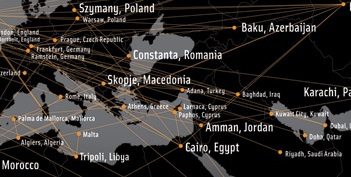
He was also involved in the project called "CIA Rendition Flights 2001-2006", which consisted of a gigantic billboard-sized mapping of all of the kidnapping by the CIA since the "War on Terror" "began" in 2001.

Labels: , ,

Monday, December 18, 2006

Year in Review

As this blog was dormant for much of the year, here we provide a detention/interrogation year in review:

January

Omar Khadr, a Canadian citizen held at Guantanamo Bay who was a minor when he was detained by US forces in Afghanistan, was arraigned by a military tribunal.

General Geoffrey Miller testifies before Congress
regarding the use of dogs on detainees in Abu Ghraib.


February

The final soldier charged with involvement of in the deaths of Habibullah and Dilawar was acquitted by US Military Courts.

Human Rights First concludes that 34 prisoners had died in US custody in Iraq and Afghanistan since 2002, and that 8-12 were tortured to death.

Federal judge David Trager throws out the suit by a Canadian who was sent to Syria to be tortured. (In 2002, Canadian citizen Maher Arar, born in Syria was passing through a New York airport, detained and subsequently "rendered" to Syria and tortured)

Prisoners riot at Policharki Jail in Afghanistan, demanding retrials.


March

Times exposes alleged abuses by the secret task force "6-26" in Iraq.

Army Sargeant Michael J. Smith is found guilty on 6 of 13 counts of abuse of detainees at Abu Ghraib, for the use of dogs on detainees. He gets 6 months jail time, when the maximum sentence would have been 8 years.


April

AP Photographer Bilal Hussein is imprisoned in Ramadi. The US claims he was apprehended with two other militants, surrounded by bombs making material. Journalist defense groups try in vain to get more information on his case.

New data released by the Detainee Abuse and Accountability Project alleges that over 600 military and contractors may have been involved in detainee abuse in Iraq. Only 40 members of the armed services have been sentenced to jailtime, and one civilian.


May

A federal judge dismisses the civil law suit against the American government brought by Khaled El-Masri, a German Lebanese-born man who was abducted by the CIA while on vacation in Macedonia in 2003. The rationale: the suit would endanger the US' national security.


June

Limited theatrical release of Michael Winterbottom's The Road to Guantanamo in the US.


July

Iranian-American filmmaker Cyrus Kar filed suit with the US government over his detention in 2005.


September

America turns Abu Ghraib, empty, over to Iraqi control. Its prisoners were moved to Camp Cropper.

President Bush claims the CIA's secret prisons across the world have been emptied.

A new Army manual for interrogation is published, banning hooding, forced nakedness and other stress positions.

AP goes public with their photographer's detention in Ramadi in April, calling for the US to either charge or release him.


October

President Bush signs the Military Commissions Act into law, according to many legal experts, denying habeas corpus rights to non-US citizens and legal aliens in the US. There is debate as to whether it denies habeas rights to American citizens. The Times calls it "a tyrannical law that will be ranked with the low points in American democracy".

Afghanistan's Reconciliation Commission visits Bagram in a bid to get more prisoners released. The number of detainees is thought to be around 500 at the time.

The US (apparently) bombs militants in the Pakistan-Afghanistan border area, killing 80 people in Pakistan's tribal area. Many were civilians.

HRW questions NATO's move towards reliance on "close air support" and bombing of civilian regions, and suggests they create a mechanism to compensate civilians affected by bombing.


November

ICG releases a report called "Countering Afghanistan’s Insurgency: No Quick Fixes" suggesting that priority be given to rule of law and fixing the judiciary.

The European Commission concludes that many EU countries were aware of the CIA's "extraordinary rendition" flights.


December

The US releases 26 detainees from Bagram Theater Internment Facility. Around 475 are believed to remain.

An ex-Navyman and security contractor in Baghdad reveals to the Times he was kept prisoner for 3 months at Camp Cropper after attemping to blow the whistle on suspicious activities by his firm. He claims he received "less legal council than Saddam."

Pakistan announces it detained over 500 Taleban and handed 400 of them over to the Afghan government.

Labels: , , , , , , ,

Sunday, March 19, 2006

Task Force 6-26 and the Black Room

The New York Times seems to have momentarily redeemed itself from the monumental screw-up of incorrectly reporting a famous Abu Ghraib detainee's identity last week.

Eric Schmitt and Carolyn Marshall detail the abuses by the infamous Task Force 6-26, a Special Forces group operating in Iraq since the invasion in 2003.


The allegations include the repeated use of detainees as paintball targets, at a secret detention facility near Baghdad airport called Camp Nama. The slogan of the group was apparently "No blood, no foul" implying that troops believed they could not be prosecuted for injuries to detainees which involved no spilling of blood.

Made up of members of the Delta Force, based at Fr. Bragg, the Navy Seal's Team 6, and the Army's Rangers, Task Force 6-26 was originally formed in 2003 as "Task Force 121" (which eventually inspired a bizarre fantasy videogame.)

TF 6-26's members have "special" privileges, they are allowed to grow beards and wear civilian clothing. The role of civilian interrogators and interpreters in the TF is unclear.

The CIA, FBI and even Army officials had warned as early as August 2003 that the situation at Camp Nama was out of control, yet no real action was taken by the Pentagon until the Abu Ghraib scandal broke in 2004. (See the memo above.)

The Times story is worth reading, as it brings more evidence and more specific allegations to light regarding the operation of the mysterious TF 6-26, its invented rituals and methods.

The abuses at Camp Nama continued despite warnings beginning in August 2003 from an Army investigator and American intelligence and law enforcement officials in Iraq. The C.I.A. was concerned enough to bar its personnel from Camp Nama that August.

It is difficult to compare the conditions at the camp with those at Abu Ghraib because so little is known about the secret compound, which was off limits even to the Red Cross. The abuses appeared to have been unsanctioned, but some of them seemed to have been well known throughout the camp. [...]

Task Force 6-26 had a singular focus: capture or kill Mr. Zarqawi, the Jordanian militant operating in Iraq. "Anytime there was even the smell of Zarqawi nearby, they would go out and use any means possible to get information from a detainee," one official said.

Defense Department personnel briefed on the unit's operations said the harsh treatment extended beyond Camp Nama to small field outposts in Baghdad, Falluja, Balad, Ramadi and Kirkuk. These stations were often nestled within the alleys of a city in nondescript buildings with suburban-size yards where helicopters could land to drop off or pick up detainees.

At the outposts, some detainees were stripped naked and had cold water thrown on them to cause the sensation of drowning, said Defense Department personnel who served with the unit.

In January 2004, the task force captured the son of one of Mr. Hussein's bodyguards in Tikrit. The man told Army investigators that he was forced to strip and that he was punched in the spine until he fainted, put in front of an air-conditioner while cold water was poured on him and kicked in the stomach until he vomited. Army investigators were forced to close their inquiry in June 2005 after they said task force members used battlefield pseudonyms that made it impossible to identify and locate the soldiers involved. The unit also asserted that 70 percent of its computer files had been lost.

Despite the task force's access to a wide range of intelligence, its raids were often dry holes, yielding little if any intelligence and alienating ordinary Iraqis, Defense Department personnel said. Prisoners deemed no threat to American troops were often driven deep into the Iraqi desert at night and released, sometimes given $100 or more in American money for their trouble.

Back at Camp Nama, the task force leaders established a ritual for departing personnel who did a good job, Pentagon officials said. The commanders presented them with two unusual mementos: a detainee hood and a souvenir piece of tile from the medical screening room that once held Mr. Hussein.

Labels: , , ,

Wednesday, March 15, 2006

US court: green light for CIA renditions

This week the Village Voice's Nat Hentoff analyzes the decision of a federal judge to throw out a suit by a Canadian citizen, alleging the US sent him illegally to be tortured in Syria.

In 2002, Maher Arar, who was born in Syria, was stopped while in transit through the US home to Canada. After being held incommunicado, he was "extraordinarily rendered" by the US to Jordan and then Syria, a country that State Department alleges tortures people regularly. In Syria, Arar was tortured and held in solitary confinement for nearly a year.

The Voice calls Judge David Trager's decision last month to throw out Arar's civil suit "startling" and "ominous." The suit was seeking damages from former US Attorney General John Ashcroft.


According to the Voice article, Trager's decision is a green light for the government to continue the CIA "extraordinary renditions." The conditions placed on detainee treatment by Congress last year do NOT apply to the CIA. Trager, unsurprisingly, is one of a large crop of Bush administration appointees.

The Trager decision tramples on the concept of "judicial review" of the Legislative and Executive branches of government. In his decision he writes the other branches of government decide where judicial oversight is appropriate.

What about the separation of powers? Ah, said Trager, "the coordinate branches of our government [executive and legislative] are those in whom the Constitution imposes responsibility for our foreign affairs and national security. Those branches have the responsibility to determine whether judicial oversight is appropriate."

Gee, I thought that the checks and balances of our constitutional system depend on the independence of the federal judiciary, which itself decides to exercise judicial review.

Judge Trager went further to protect the Bush administration's juggernaut conduct of foreign policy: "One need not have much imagination to contemplate the negative effect on our relations with Canada if discovery were to proceed in this case, and were it to turn out that certain high Canadian officials had, despite public denials, acquiesced in Arar's removal to Syria."

"More generally," Trager went on, "governments that do not wish to acknowledge publicly that they are assisting us would certainly hesitate to do so if our judicial discovery process could compromise them."

But judge, the Canadian government itself is now actively involved in an inquiry to discover, among other things, what happened to Arar, and how. And in Europe, there is a fierce controversy over whether governments there have been covertly involved in facilitating the CIA's kidnapping of terror suspects from other lands.

Is it the job of a federal judge here to protect other governments from embarrassment and eventual punishment by their own courts for helping the United States commit crimes?

And what about our own government's criminal accountability? The February 17 New York Law Journal noted that "Judge Trager said that even assuming the government had intended to remove Maher Arar to Syria for torture, the federal judiciary was in no position to hold our government officials liable for damages 'in the absence of explicit direction by Congress . . . even if such conduct violates our treaty obligations or customary international law.' " (Emphasis added.)

Labels: , ,

Monday, February 06, 2006

Ex-CIA contractor allowed to blame "orders"

Ex-CIA agent David Passaro, an ex-special forces officer and policeman, who was hired by the CIA as a "contract worker" is being allowed to present evidence in his trial for the death of Abdul Wali, that he was "ordered" to interrogate the prisoner. The district judge of Eastern North Carolina was quoted by the AP as saying "In order to fairly evaluate whether the facts in this case warrant a public authority defense, the court must hear the proof at trial."

To hear and/or read about Abdul Wali's final days, please read this prior blog entry about the testimony of a teenage Afghan-American boy who actually convinced Wali to turn himself in to the Americans.

Labels: , , , , , ,

Wednesday, December 28, 2005

CIA "investigating" worst renditions

The CIA's Inspector General, who is charged with independently investigating the organization, is looking into about 10 alleged cases of "erroneous rendition" -- i.e. kidnapping and delivering to other governments, coincidentally those that torture.

The US government estimates that up to 150 people have been apprehended all over the world by US government agents and sent to third countries for "interrogation" (often countries where interrogation is synonymous with torture like Jordan and Egypt).

The Inspector General is specifically looking into the cases of Khaled Al-Masri, a German citizen of Lebanese origin, and Mamdouh Habib, an Egyptian-born Australian. It is not concidental that one man is suing the US government, and the other has threatened to sue the Australian government.

This CIA investigation is announced shortly after Secretary of State Condoleezza Rice made a public denial of any "rendition" to a country where a detainee would likely be tortured. Isn't it the very same State Department which issues yearly reports on Human Rights in countries like Egypt ("the security forces continued to mistreat and torture prisoners"), Jordan ("reported continuing abuses included police abuse and mistreatment of detainees, allegations of torture"), and Syria ("continuing serious abuses included the use of torture in detention, which at times resulted in death")? And, for the record, the US denies "rendering" any detainees to Syria, but a Canadian citizen Maher Arar is suing the US for his "rendition" to Syria.

Labels: , , ,

Thursday, December 22, 2005

Interrogation contractor on PR warpath

CACI, the infamous contractor to the CIA used for interrogation in Iraq until the Abu Ghraib scandal broke in 2004, continues to attack its critics even when it seems the public has largely forgotten or overlooked their role in abuse of detainees.

A Minnesota alternative magazine recounts the reponse of irate CACI president J. P. London, who wrote a strange letter contesting a recent story by the magazine about CACI's lobbying efforts in Congress. The prior article referred to the fact that CACI and other contractors spend hundreds of thousands of dollars indirectly promoting conflict, or the expansion of conflict, in order to further profit from them.

In his "I wish to protest in the strongest possible terms" letter, London quotes various figures in the Abu Ghraib investigation out of context and constructs his case over two pages . This would be a laughing matter for the Minnesota magazine, if it were not for the threat of legal action by CACI, as the firm recently sued Air America radio for $10 million dollars for defamation.

This posturing can only be intended to distract from the fact that CACI is involved in a class-action suit for its role in the abuse of various Iraqi detainees, and that the company, which had virtually no experience in the field of interrogation, has seemingly soiled its reputation for good by getting involved in it.

Labels: , , , ,

Monday, December 19, 2005

Secret "dark prison" in Afghanistan

Human Rights Watch published a new press release documenting the existence of a secret CIA prison in Afghanistan until at least late 2004. The so-called "dark prison" has been independently described by various detainees in US custody (or ex-detainees). There were no uniformed US personnel operating in the "facility" which was kept in near total darkness. The report claims detainees were strapped up against walls, sleep deprived, and subjected to days and days of heavy metal and hip-hop (specifically Eminem and Dr Dre). They were often kept in shackles which caused their hands to swell.

Read the entire story at the HRW site.

Labels: , , , ,

Friday, December 16, 2005

Bush forced to ban torture

This week Senator John McCain, backed by strong majorities in both houses of Congress, was able to force the Whitehouse to agree to a ban torture by the US government (with the exception of the CIA). The ban is contained in the Defense Spending bill, which was held up in Congress for months past the usual date, largely due to resistance by Vice President Dick Cheney.

The LA Times explains the political process well, the way in which the Bush administration was forced to accept the reality that the American public would not stand behind institutionalized torture.

Ironic, that a Whitehouse so possessed by Christian fervor, was so unable to accept McCain's personal appeal, based in his painful experience in Hanoi as prisoner of war, to "turn the other cheek" to torture.

Labels: , , , ,

Wednesday, November 16, 2005

Horror in Iraq: who is mimicking who?


Two Iraqi businessmen report, as a part of their lawsuit in US court, that they were thrown into the lion cage in one of Saddam's palaces, shortly after the invasion of their country, by US troops. They were beaten repeatedly and asked where Saddam was and about weapons of mass destruction, and experienced numerous "mock executions."

And this same week US troops burst into the putrid basement of a building of the Ministry of the Interior in a Baghdad suburb, to discover 173 undocumented, tormented, tortured prisoners. There were teenagers in the group, and according to some, the vast majority were Sunni Arabs. (This discovery did not surprise many Iraqis, especially Sunni.)

The Deputy Ministry of the Interior, Hussein Kamal, after inspecting the prisoners, which he claims he was totally unaware were in the Ministry's custody, said to CNN, "I saw signs of physical abuse by brutal beating, one or two detainees were paralysed and some had their skin peeled off various parts of their bodies."

In the past year numerous reports, by Sunnis, Iraqi human rights groups, Western human rights groups, and major western media have detailed the brutal free reign of certain elements Iraqi defense forces.

The building in question was reportedly run by "police commandos" and the Iraqi Ministry of the Interior has vehemently denied their connection to a group with links to Iran called the Supreme Council for Iraqi Revolution.

The Iraqi government consented to these raids after meetings with the American ambassador and military commanders, according to American officials.

In a rather ironic twist, after Abu Ghraib and last week's allegations of secret CIA detention facilities in Afghanistan and Eastern Europe, Brigadier General Karl Horst of the 3rd Infantry Division, the commander of the raid, stated to the LA Times that he would "hit every last one" of the secret detention facilities.

It seems clear that any investigation into this discovery will prove that the combination of torture and impunity that the Bush administration has cultivated during the occupation has indeed provided fertile ground for the Iraqi version to flourish.

Labels: , , , , ,

Tuesday, November 15, 2005

Torture does not work, ask the CIA

In the LA Times, from an ex-CIA counter-terrorism chief, it's all explained here: what John McCain and 89 other senators already know.


If you inflict enough pain on someone, they will give you information, but what they tell you may not be true. You will have to corroborate it, which will take time. And, unless you kill every suspect you brutalize, you will make enemies of them, their families, maybe their entire villages. What real CIA field officers know firsthand is that it is better to build a relationship of trust — even with a terrorist, even if it's time-consuming — than to extract quick confessions through tactics such as those used by the Nazis and the Soviets, who believed that national security always trumped human rights.

Labels: , ,

Monday, November 07, 2005

Alleged CIA "black sites" in E. Europe

The Washington Post's story revealing two secret prisons in Eastern European nations made shockwaves this week in Europe and around the world.

Dana Priest's reporting, which necessarily relied on anonymous "intelligence officers" as sources, details the creation of a web of secret prisons starting with the war in Afghanistan in 2001. At one point there were prisons in Thailand, Afghanistan and "small democracies in Eastern Europe." The CIA subsequently shut the prison in Thailand at the request of the Thai government.

The "Salt Pit" (referred to in abuse documents) remains open in Afghanistan. According to Priest's report, in total the CIA holds about 30 "high-value" prisoners, an unknown number remaining in the two mentioned sites in Eastern Europe.

Since the article's publication November 2, Human Rights Watch came forward with evidence that the CIA's "rendition" program made repeated trips with charter jets to airfields in Poland and Romania, suggesting that these were the two countries hosting secret CIA facilities.

Following this report, there was swift reaction in Europe, as it would seem rather scandalous that EU member states could host prisons which are in contravention of numerous European and international laws and treaties. Polish officials admitted that a plane did in fact touch down on the tarmac at a remote, rarely-used airfield on the very day that HRW claims a CIA-chartered plane landed there. Romanian officials denied entirely the insinuation that the CIA holds prisoners at one of its airport facilities.

The Council of Europe's Human Rights chief Alvaro Gil-Robles was the most outspoken, following the HRW allegations, calling for an investigation.

But a European Union spokesman said only with more evidence would the EU investigate the allegations, which both Polish and Romanian officials have denied.

One wonders whether for lack of further evidence, this story and investigation into the possibility of CIA "black sites" in Eastern Europe will die. Interesting are to be raised, if indeed the allegations are true: why Europe? Why didn't the CIA use Central Asian airbases? Why wasn't the "Salt Pit" in Afghanistan sufficient to hold the 30 "high value" prisoners?

Labels: , ,